
Projected POCUS Utilization in Urgent Care: What 10,000 Patient Visits Reveal
Point-of-care ultrasound (POCUS) adoption in urgent care has lagged behind emergency medicine and primary care.
Two central questions have driven that hesitation:
1. How often would POCUS actually be used in urgent care?
2. Would it be financially viable?
A newly published study in the Journal of Urgent Care Medicine addressed both questions using a structured modeling approach applied to 10,000 real adult urgent care encounters.
The research used de-identified intake data and a physician-refined prediction model to simulate when POCUS would be clinically indicated. A financial model was then applied to estimate projected reimbursement and break-even thresholds under conservative assumptions.
Question 1: How Often Would POCUS Be Used in Urgent Care?
The model predicted that 9.2% of adult urgent care visits would qualify for at least one POCUS exam.
That represents nearly 1 in 10 visits.

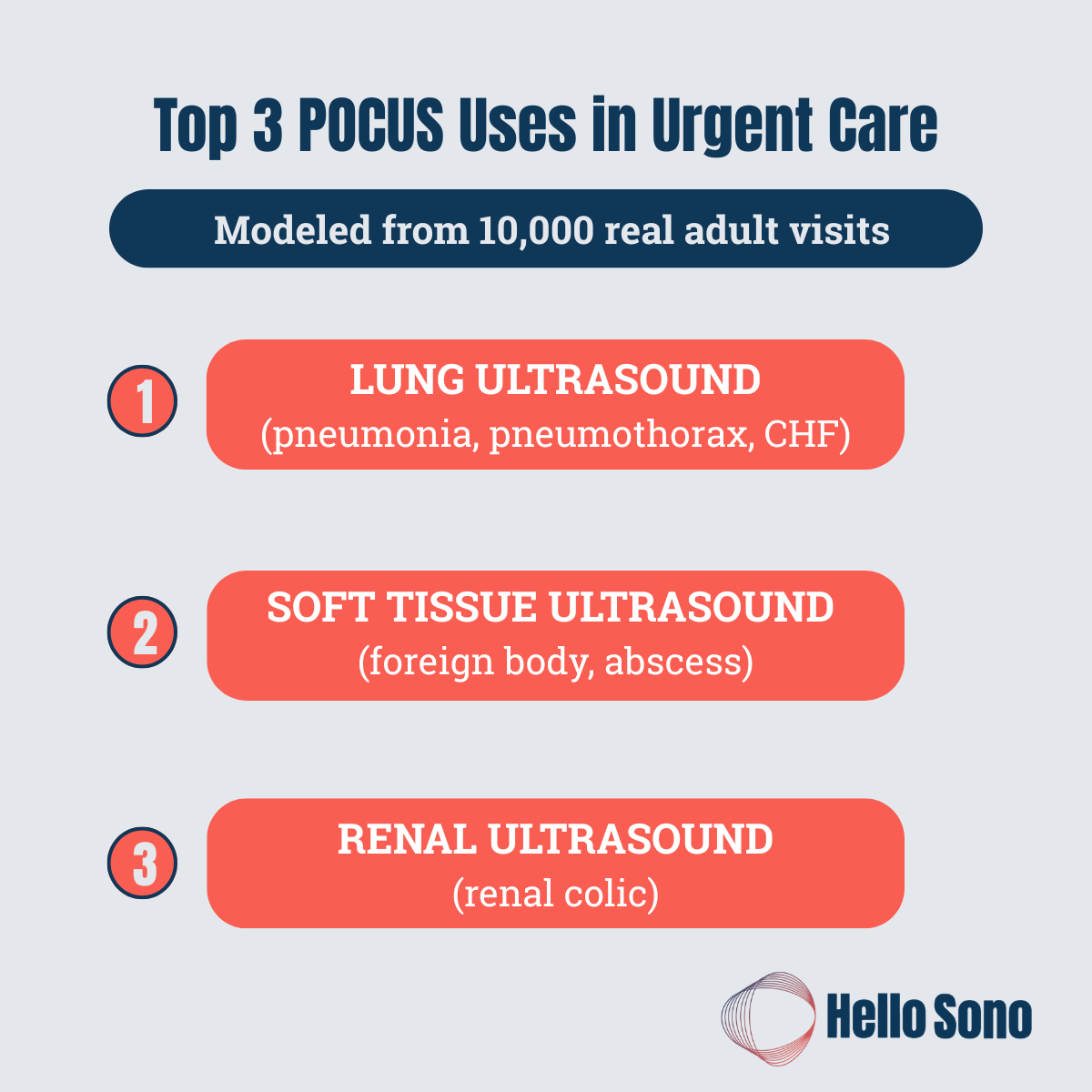
Approximately 78% of projected POCUS use involved respiratory indications.
Given the high volume of cough, dyspnea, and suspected pneumonia in urgent care settings, this finding has practical implications. Lung ultrasound has strong supporting evidence in the literature and may meaningfully influence diagnostic efficiency in respiratory cases.
Other projected indications included:
Hydronephrosis
Gallbladder pathology
Soft tissue abscess
Soft tissue foreign body
Deep vein thrombosis
Why 9.2% Is Likely Conservative
The model did not include several common urgent care populations and indications, including:
Musculoskeletal injuries (fractures, tendon tears, joint effusions)
Pediatric patients
High-acuity cases referred directly to the emergency department
Musculoskeletal complaints alone represent a substantial portion of urgent care volume. Inclusion of these use cases would likely increase projected utilization.
The 9.2% estimate therefore represents a baseline for adult urgent care modeling.
Question 2: Is POCUS Financially Viable in Urgent Care?
After estimating projected clinical use, researchers applied conservative After estimating projected clinical use, researchers applied conservative Medicare reimbursement assumptions within a fee-for-service payer model to project potential revenue.
Findings included:
Estimated reimbursement of approximately $55,239 per 10,000 visits
Break-even projected between 1,258 and 3,354 POCUS encounters annually, depending on organizational scale
Under these assumptions, many average-volume urgent care centers could reach revenue neutrality within approximately 1–2 years after billing initiation.
These projections assume appropriate credentialing, workflow integration, and billing optimization. As handheld devices continue to decrease in cost and AI-assisted acquisition reduces training barriers, financial feasibility becomes increasingly attainable.
Why This Study Matters
For years, discussions about POCUS in urgent care have relied on extrapolation from emergency medicine and primary care research.
This analysis provides large-scale, urgent care-specific modeling data.
It quantifies projected clinical demand.
It evaluates financial feasibility using transparent assumptions.
It identifies thoracic ultrasound as a high-yield starting point.
It also has operational implications. Radiologic technologist shortages continue to affect urgent care centers nationwide, limiting consistent access to on-site X-ray and disrupting workflow. POCUS offers a clinician-operated, point-of-care imaging solution that can help mitigate some of these operational bottlenecks, particularly for respiratory and soft tissue presentations.
Real-world urgent care-based validation studies remain an important next step. However, this work represents a meaningful foundation for data-driven implementation planning.
Ready to take the next step with POCUS? Hello Sono helps practices roll out high-quality, compliant, and profitable POCUS programs.
Study Citation:
Weissert J, Russell J, Havryliuk T. Algorithmic Prediction of Utilization and Financial Viability Modeling for Point-of-Care Ultrasound (POCUS) in Adult Urgent Care Patients. Journal of Urgent Care Medicine. 2026;20(5):25–31.
Author affiliations include Intellivisit Solutions | UCP-Merchant Medicine and Hello Sono LLC.