

Blog

POCUS Implementation in Urgent Care: What the Data Shows
Until now, very little published research has looked at what actually happens once urgent care providers are trained in POCUS and supported with an ongoing quality assurance (QA) program.
In this blog we dissect the article published in the Journal of Urgent Care Medicine that demonstrated two-fold reduction in ED transfers for patients with soft tissue and musculoskeletal complaints once POCUS was implemented through structured training and quality assurance by the ultrasound faculty at affiliated hospital.

Spotting Acute Cholecystitis on POCUS: What to Look For, What Fools You, and Why it Matters
A 45-year-old woman with no past medical history presents to the emergency department with right upper quadrant pain that started about 10 hours ago, shortly after dinner. This time, the pain hasn't subsided and has been constant since it started.
Discover how point-of-care ultrasound (POCUS) can aid in the bedside evaluation of acute cholecystitis. Through a real clinical case, learn the classic ultrasound findings, differentiate cholecystitis from biliary colic, recognize common imaging pitfalls, and understand the evidence supporting gallbladder POCUS.

What Does the Evidence Show? Lung Ultrasound vs Chest X-ray in Urgent Care and Primary Care
Lung ultrasound outperforms traditional chest X-rays in accuracy, speed, and cost for urgent and primary care settings, providing superior sensitivity for detecting pneumonia, pneumothorax, and pulmonary edema without radiation. As a practical alternative to radiography-related operational challenges, POCUS offers real-time bedside diagnostic capabilities.

Do You Need a CT? POCUS in First-Time Renal Colic
A 24-year-old man presents to urgent care with first-time renal colic. He is stable, tolerating oral intake, and has no signs of infection. Does he need a CT scan or emergency department referral?
In this Southern Medical Association case article, we explore how renal point-of-care ultrasound (POCUS) identified mild hydronephrosis at the bedside, allowing safe outpatient management without CT imaging or ED transfer. The article reviews key renal ultrasound findings, common pitfalls, evidence supporting a POCUS-first approach, and the broader impact on radiation exposure, healthcare utilization, and cost.
Learn how POCUS can help clinicians rapidly risk stratify patients with suspected renal colic while improving patient-centered care.

Rib Fracture Missed on Chest X-ray: How Point of Care Ultrasound Changed Management After a Skiing Fall
A 51-year-old male presented to urgent care after falling while spring skiing. He reported catching an edge, pitching forward, and landing forcefully onto his left anterior chest. He immediately experienced localized pain, worsened by deep inspiration. He denied shortness of breath, syncope, and head or neck injury.
Vital signs were normal. Examination demonstrated focal tenderness over the left anterior chest wall at the level of the fourth rib without visible ecchymosis, crepitus, or deformity. Lung sounds were clear and equal bilaterally.
A chest X-ray showed no acute bony abnormality and no pneumothorax. Due to persistent focal pain, point-of-care ultrasound (POCUS) was performed over the area of maximal tenderness.

Recognizing Acute Right Heart Strain with POCUS: The D-Sign in Pulmonary Embolism
A 41-year-old woman presents to the emergency department with a sudden onset of dyspnea and pleuritic chest pain for two hours. She appears mildly anxious and diaphoretic. She denies fever, cough, trauma, or recent illness. She takes oral contraceptives and has no significant past medical history.
Vital signs reveal HR 113 bpm, RR 24, O₂ saturation 94% on room air, and BP 110/74 mmHg.
Her lung exam is clear. Cardiac exam reveals tachycardia without murmurs.

Projected POCUS Utilization in Urgent Care: What 10,000 Patient Visits Reveal
Projected POCUS Utilization in Urgent Care: What 10,000 Patient Visits Reveal
New urgent care research shows nearly 1 in 10 adult visits could be candidates for point-of-care ultrasound (POCUS), supporting utilization estimates and modeling the financial viability of implementing ultrasound in UC.

A Young Adult with Worsening Cough: Using Lung POCUS to Diagnose Early Pneumonia
A 24-year-old man presents to a primary care clinic with seven days of respiratory symptoms. He initially developed cough, fever, sore throat, and fatigue. His symptoms improved on days 4 and 5, but then worsened in the past 48 hours with recurrent fever and productive green sputum.
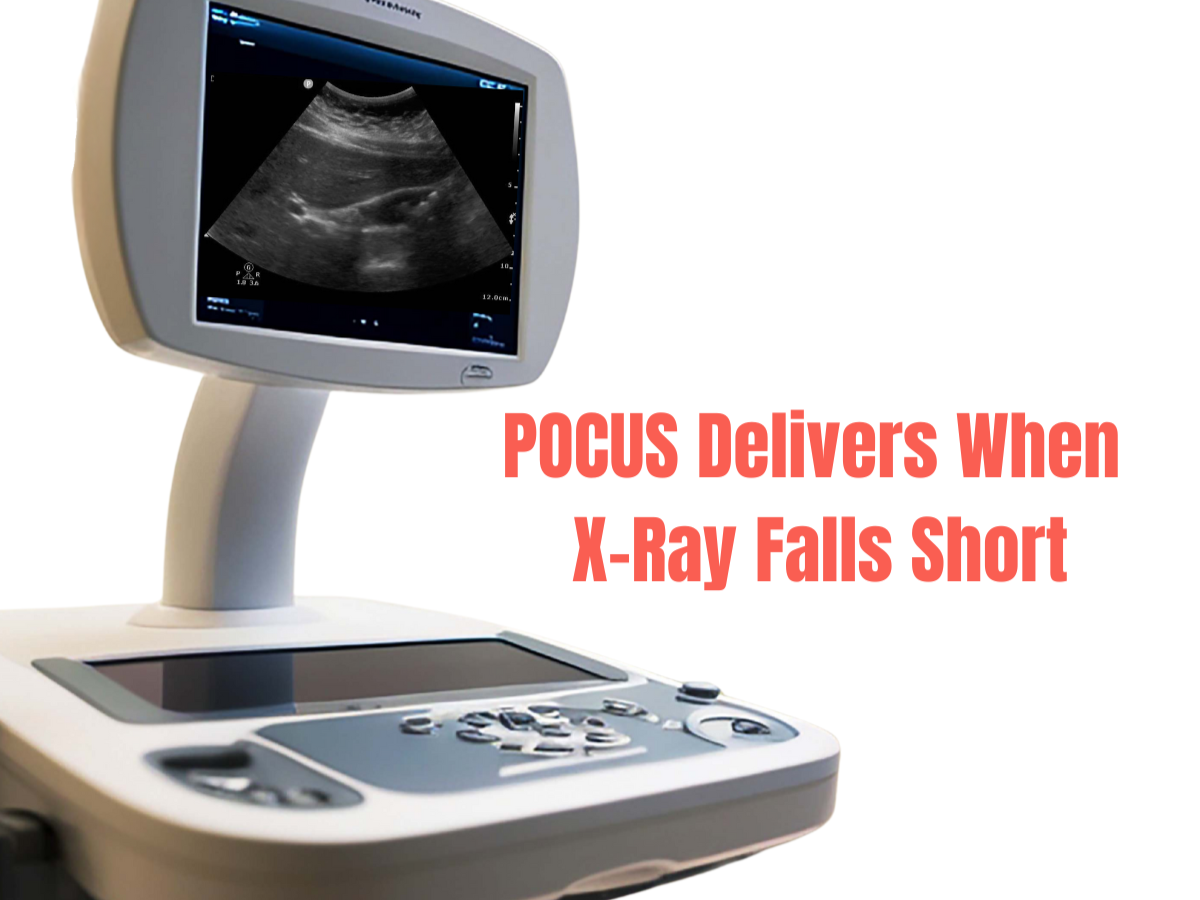
The New Backbone of Urgent Care Imaging: Why POCUS Matters Now
Urgent care centers are built on access, efficiency, and rapid diagnostics. For decades, X-ray has been central to that model. Yet many operators are finding that maintaining consistent radiography is becoming increasingly difficult. A nationwide shortage of radiologic technologists has pushed wages upward and made staffing unpredictable. [1] Imaging volumes are often too low to justify the cost of full-time personnel. Reimbursement structures rarely offset the true expense of equipment, inspections, overreads, and service contracts. As a result, X-ray, once a dependable service line, is now one of the most operationally fragile components of urgent care.
It is important to recognize that there is still a strong role for X-ray in centers with consistently high imaging volume or significant orthopedic demand. In those environments, radiography remains essential. The challenge is that radiography alone cannot meet the operational and workforce pressures facing urgent care today. When staffing is unreliable, imaging availability becomes inconsistent, and that inconsistency affects patient flow, provider confidence, and payor relationships.
Stay in the loop.
Sign up with your email address to receive news and updates about POCUS and Hello Sono.