
The Business Case for POCUS: A Practical Guide to Revenue, Cost Savings & Efficiency (Webinar Recording)
You can view the full episode on YouTube at the link here.
Practices considering whether to add or expand point-of-care ultrasound (POCUS) often run into the same question: does the investment pay off, and how do you make that case internally?
While the clinical value of POCUS is well established, the financial case is often what determines whether a practice moves forward with equipment, training, and the workflow changes needed to support it.
In this webinar, presented by Dr. Tatiana Havryliuk, we review a practical framework for understanding how POCUS creates financial value, including direct billing, cost savings from avoided complications, cost avoidance from reduced imaging overhead, and what a practice needs in place to bill and document compliantly.
Watch the full recording:
What You'll Learn About the Business Case for POCUS
This practical session focuses on translating POCUS use into terms clinicians and administrators can act on.
You'll learn:
Current Medicare non-facility payment rates for common point-of-care exams and procedures
How avoiding costly complications and hospital admissions contributes to overall cost savings
How reducing reliance on underutilized imaging infrastructure creates cost avoidance
What billing readiness requires, including documentation standards, training, and payer contract review
How to estimate first-year investment and ongoing costs for a POCUS program
Key Financial Impact Categories Explained
Understanding where POCUS creates value starts with separating it into distinct categories, each with its own drivers and requirements.
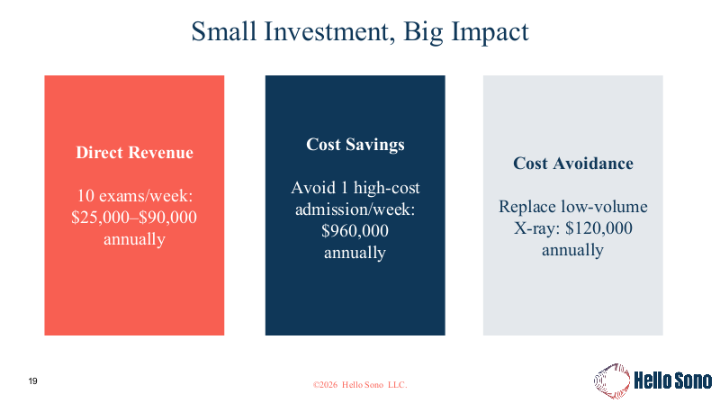
Direct Revenue: Billing for diagnostic and procedural point-of-care exams — such as limited echocardiography, biliary, DVT, FAST, and ultrasound-guided procedures — using current Medicare non-facility rates as a baseline.
Cost Savings: Fewer high-cost clinical events, such as avoidable hospital admissions or emergency department transfers, because conditions like CHF, pneumonia, sepsis, and AAA are identified earlier at the bedside.
Cost Avoidance: Reduced reliance on underutilized imaging infrastructure and staffing — most relevant for practices with lower X-ray volume, where POCUS can offset a fixed structural cost rather than prevent a single event.
Key Takeaways
POCUS can create multiple, distinct financial benefits rather than a single revenue stream
Documentation and appropriate training are essential
Payer mix and local contracts meaningfully change what a given practice can expect to see
“Cost savings and cost avoidance are related, but distinct: cost savings means fewer expensive events happen; cost avoidance means removing a fixed structural cost altogether.”
Next Steps
Try our ROI Calculator to estimate the financial impact
Download our Billing Readiness Checklist to assess where your program stands today
Fill out the contact form to speak to an expert
Understanding the framework is only the beginning. Turning POCUS program into a compliant, sustainable and financially sound service requires ongoing documentation, training, and oversight.
Hello Sono support practices through:
Structured POCUS training
Longitudinal exam review and ongoing QA
POCUS program implementation
Learn more about the POCUS Exam Review: Here