
POCUS Implementation in Urgent Care: What the Data Shows
Point-of-care ultrasound (POCUS) has expanded across emergency departments, inpatient units, and outpatient clinics, with a growing body of evidence linking its use to improved patient outcomes and shorter length of stay. Urgent care has been slower to build this evidence base.
Until now, very little published research has looked at what actually happens once urgent care providers are trained in POCUS and supported with an ongoing quality assurance (QA) program.
A newly published study in the Journal of Urgent Care Medicine addressed that gap, measuring real-world ED transfer rates before and after a structured POCUS training and QA program at a single urgent care clinic.
The Training and QA Program
Ten urgent care providers at a community-based clinic affiliated with Denver Health completed a 1-day POCUS training course covering four applications: aorta, renal, soft tissue/musculoskeletal (ST/MSK), and transabdominal first-trimester pregnancy.
Training alone was not the endpoint. Following the course, providers submitted their clinic-performed scans for ongoing quality assurance, with a goal of 25 reviewed scans per application, aligned with hospital credentialing requirements. Every scan and interpretation was reviewed by POCUS experts.
What the Data Showed
Researchers compared ED transfer rates for two common urgent care complaints in the 10 months before and after the program launched:
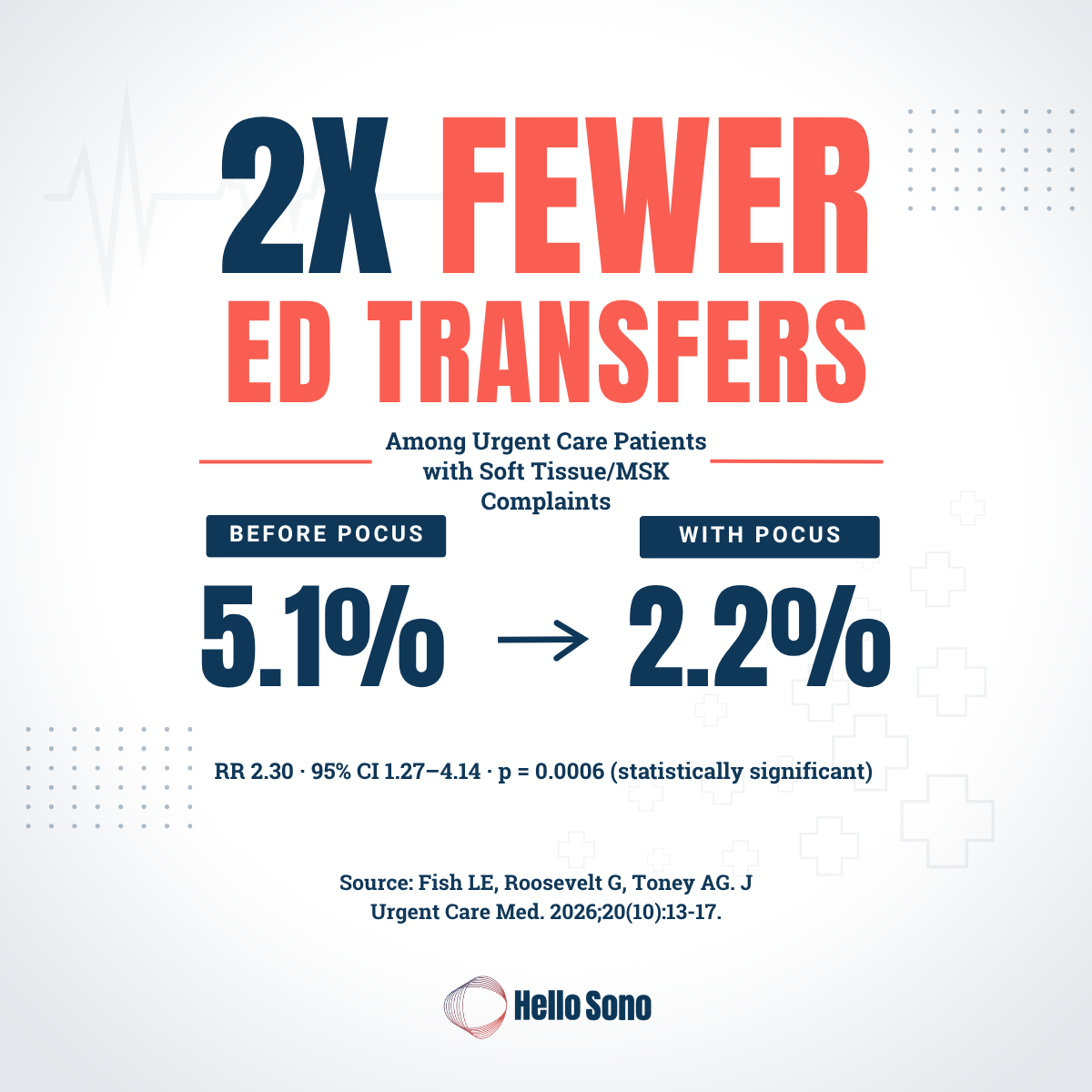
ST/MSK complaints: ED transfers dropped from 5.1% to 2.2%, a statistically significant twofold reduction (RR 2.30, 95% CI 1.27–4.14, p=0.0006).
First-trimester pregnancy complaints: ED transfers dropped from 28% to 20%, a trend in the same direction, though not statistically significant in this sample (RR 1.42, 95% CI 0.99–2.05, p=0.06).
Patient demographics and clinical characteristics were similar before and after the training course, supporting the change being attributable to the POCUS program rather than a shift in the patient population.
Why This Matters
Fewer unnecessary ED transfers means patients get an answer and a next step without an added trip, an added wait, and in many cases an added round of testing for the same complaint.
The reduction in transfers did not come from training alone. It came from training paired with real oversight: structured image review, a defined scan volume per application, and a QA process aligned with hospital credentialing standards. That combination is what turned a 1-day course into a sustained clinical impact, and it's a useful model for any urgent care group building or refining a POCUS program.
The authors also note that this kind of program may support UC POCUS credentialing more broadly, since ongoing QA doubles as a documented pathway for demonstrating and maintaining competency.
Limitations
This was a single-center, retrospective study, which limits how broadly the findings generalize to other urgent care settings. The authors did not directly measure length of stay, radiology utilization, patient experience, or patient costs, though they reasonably infer that fewer transfers likely reduced length of stay, costs, and radiology utilization. Larger, multicenter studies are needed to confirm these findings.
Key Takeaway
This study is one of the first to demonstrate, with real outcomes data, that POCUS implementation in urgent care works when it's built the right way: structured training paired with ongoing, credentialing-aligned quality assurance. The result was fewer unnecessary ED transfers and more care resolved at the point of contact. It's a strong example of what implementation done well can look like.
Related Reading
Curious what POCUS demand and financial viability could look like in your own urgent care setting? See our recap of a companion study: Projected POCUS Utilization in Urgent Care: What 10,000 Patient Visits Reveal.
Ready to Take the Next Step With POCUS?
Hello Sono helps practices roll out high-quality, compliant, and profitable POCUS programs.
Study Citation
Fish LE, Roosevelt G, Toney AG. The Impact of an Urgent Care Point-of-Care Ultrasound Program on Patient Transfers to the Emergency Department. J Urgent Care Med. 2026;20(10):13-17.